


Balance training equipment is a great way to improve stability, strengthen your core, and reduce the risk of injury. Whether you're new to fitness, recovering from an injury, or looking to enhance daily movement, these tools offer simple, low-impact ways to boost coordination and confidence. From balance boards to BOSU balls, each piece of equipment provides unique benefits tailored to different fitness levels and goals.
Key Takeaways:
- Core Strength: Tools like wobble boards and stability balls engage stabilizer muscles for better balance and posture.
- Injury Prevention: Regular balance training can lower injury risk by over 40%.
- Everyday Functionality: Improves coordination for daily tasks like walking or bending.
- Beginner-Friendly: Start with foam pads or wobble cushions for safe, gentle exercises.
- Compact Options: Many tools are small and easy to store, ideal for home workouts.
Popular Balance Tools:
- Balance Boards: Build ankle strength and proprioception.
- BOSU Balls: Versatile for cardio, strength, and core workouts.
- Stability Balls: Great for core exercises and active sitting.
- Wobble Cushions: Perfect for small spaces and office use.
- Vibration Plates: Stimulate muscle engagement and recovery.
The right equipment depends on your fitness level, space, and goals. Start small, progress gradually, and enjoy the benefits of improved balance and strength in your daily life.
How To Choose The Balance Training Tool That's Right For You
sbb-itb-d98c2fb
Benefits of Balance Training Equipment
Balance tools are a game-changer for improving stability and making everyday movements safer and more efficient.
Better Core Strength and Stability
Standing on an unstable surface - like a balance board or a BOSU ball - automatically activates your stabilizer muscles. These include your abs, back, and pelvic muscles, which all work together to keep you steady. Because your body constantly adjusts to maintain balance, this type of training engages your core more effectively than many traditional exercises.
It also boosts proprioception, your body's ability to sense its position in space. Improved proprioception leads to better joint stability and reduces the likelihood of falls. In fact, research has shown that balance training can lower injury risk by over 40% [6]. A 2011 study even found that older adults who used a wobble board twice a week for nine weeks significantly enhanced their standing balance [9].
"Focusing on your core and balance improves overall strength and gets your body ready for more advanced exercise." - Dr. Michael Smith, WebMD [7]
Better Coordination and Functional Fitness
Balance equipment doesn’t just help you stay steady - it makes you more coordinated in everyday scenarios. Training on unstable surfaces prepares your body for unpredictable movements, like navigating uneven sidewalks, carrying heavy bags, or reaching for something on a high shelf.
This type of training also enhances Activities of Daily Living (ADL) - the basic tasks you perform every day. Whether it’s walking, getting up from a chair, or bending to tie your shoes, improved coordination makes these movements easier and safer. Essentially, balance training mirrors the dynamic movements required in daily life.
"We live in 360 degrees, and life comes at us from all angles and speeds." - Abrea Wooten, Senior National Education Manager at Life Time [3]
Low-Impact Training for Beginners
One of the best things about balance training is that it’s low-impact. There’s no need for running, jumping, or high-intensity exercises. Instead, you focus on slow, controlled movements that are gentle on your joints while still building strength and stability.
This makes it ideal for those with joint issues like arthritis or anyone recovering from an injury. Starting with a foam balance pad is a great option - it provides just enough instability to challenge your body without adding stress. As your confidence grows, you can gradually move on to more advanced tools and exercises, increasing the intensity at your own pace.
"The beauty of balance training is that anyone can, and should, do it. Balance training improves the health, balance, and performance of everyone from beginners to advanced athletes." - Dr. Michael Smith, WebMD [8]
Ready to take the next step? There’s a wide range of balance equipment designed to help you achieve your fitness goals.
Types of Balance Training Equipment
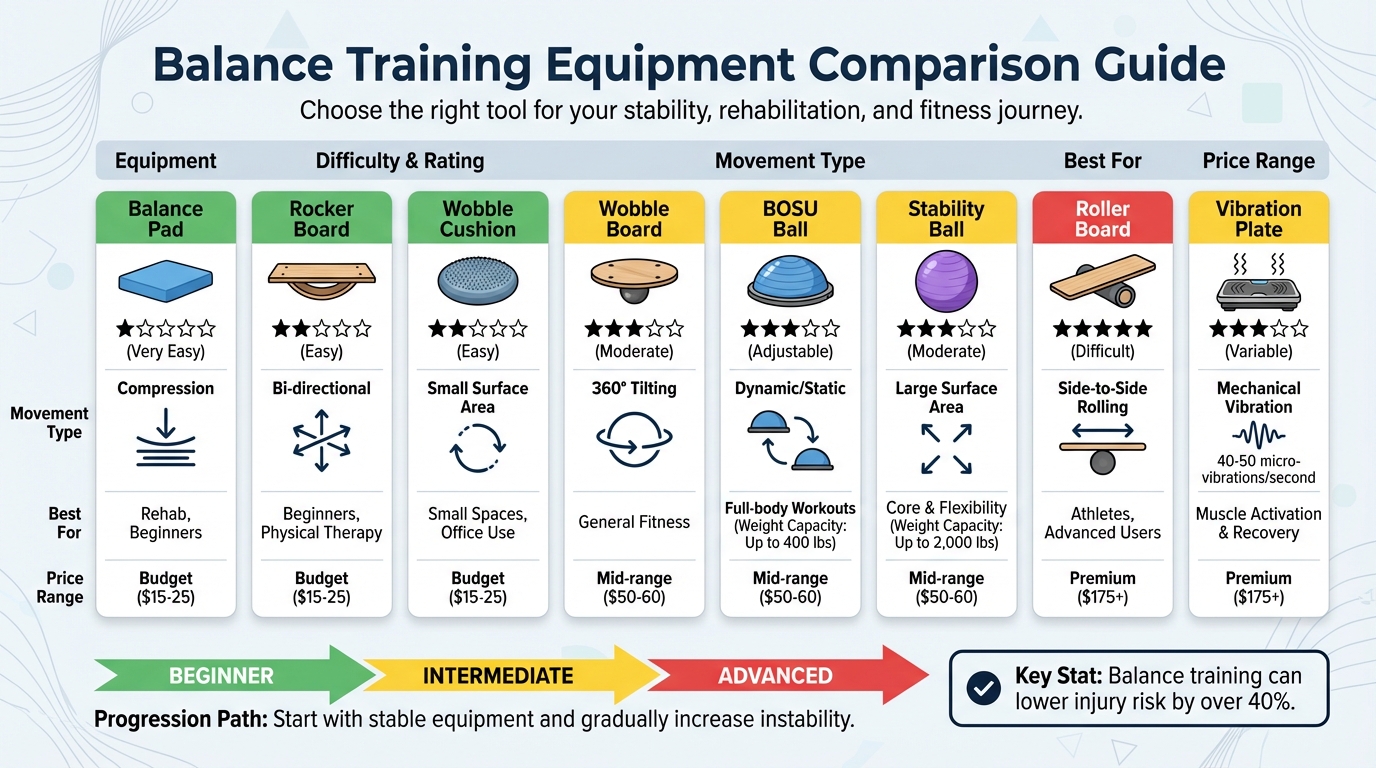
Balance Training Equipment Comparison Guide: Types, Difficulty Levels, and Best Uses
Finding the right balance training equipment depends on your fitness level, available space, and specific goals. Here’s an overview of some popular options:
Balance Boards
Balance boards feature a pivoting surface that challenges your stability and strengthens your ankles. For beginners, a rocker board is a great starting point as it moves in just two directions - front-to-back or side-to-side. As you advance, a wobble board offers a spherical base, allowing 360° tilting for a tougher workout. For seasoned users, the rocker-roller board introduces an unattached cylindrical roller for a dynamic challenge.
These tools are excellent for building ankle strength and improving proprioception - your body’s awareness of its position in space. Research even shows standing on a balance board increases energy expenditure by 14.2% compared to sitting [9].
BOSU Balls
The BOSU Ball - an acronym for "Both Sides Utilized" - is a versatile piece of equipment featuring a 26-inch inflatable dome attached to a rigid platform. Use it dome-side up for a stable base during static exercises, or flip it over for a 360° dynamic challenge. It’s perfect for cardio, strength, and core workouts, and high-quality models can support up to 400 lbs [12].
Stability Balls
Also called Swiss balls, these large inflatable spheres create an unstable surface that keeps your stabilizing muscles constantly engaged. They’re particularly effective for improving core strength and flexibility. Stability balls can also double as desk chairs, helping improve posture while keeping your core active throughout the day. High-quality versions can support up to 2,000 lbs [5].
Wobble Cushions
Compact and beginner-friendly, wobble cushions are air-filled discs made from durable materials like PVC. They’re great for balance exercises or "active sitting", which engages your core and lower back muscles. Their small size makes them a practical choice for tight spaces, and they’re often one of the most affordable balance training tools available.
Vibration Plates
Vibration plates use high-frequency vibrations - typically between 40 and 50 micro-vibrations per second - to stimulate blood flow and trigger rapid muscle contractions [6]. This creates a slightly unstable surface, requiring constant muscle engagement to maintain balance. They’re particularly effective for muscle activation and recovery, offering a unique twist compared to traditional balance tools.
| Equipment Type | Movement Type | Difficulty Level | Best For |
|---|---|---|---|
| Balance Pad | Compression | Very Easy | Rehab, Beginners |
| Rocker Board | Bi-directional | Easy | Beginners, Physical Therapy |
| Wobble Board | 360° Tilting | Moderate | General Fitness |
| BOSU Ball | Dynamic/Static | Adjustable | Full-body Workouts |
| Stability Ball | Large Surface Area | Moderate | Core & Flexibility |
| Wobble Cushion | Small Surface Area | Easy | Small Spaces, Office Use |
| Roller Board | Side-to-Side Rolling | Difficult | Athletes, Advanced Users |
| Vibration Plate | Mechanical Vibration | Variable | Muscle Activation |
Up next: Learn how to select the perfect balance training equipment based on your fitness goals and space constraints.
How to Choose Balance Training Equipment
Balance tools, as mentioned earlier, are great for improving stability and core strength. But picking the right one depends on your fitness level, goals, and how much space you have. Let’s break down how these factors influence your decision.
Match Equipment to Your Fitness Goals
Your fitness goals should guide your choice of balance equipment. For those recovering from injuries or dealing with joint issues, a balance pad is a gentle option that helps build ankle strength gradually [5]. If you’re looking to improve posture and engage your core during the workday, consider a wobble cushion or stability ball. These tools encourage active sitting by working your core and pelvic muscles [1][5].
Athletes or anyone aiming to boost agility and sport-specific skills might benefit from wobble boards, which allow for 360° movement. They’re excellent for challenging coordination and footwork [1][2].
Consider Your Space and Storage Needs
Space is another important factor. If you’re short on room, compact tools like balance pads and wobble cushions are easy to store - they can slide under a bed or fit into a closet [5]. Wooden wobble boards are lightweight (usually under 4 lbs) and portable, making them a convenient choice [4][5].
On the other hand, BOSU balls and stability balls take up more space and require dedicated storage [1]. For smaller home gyms, opt for flatter, more compact equipment. Some balance discs even double as cushions for office chairs, offering both functionality and easy storage [1][5].
Start with Beginner-Friendly Equipment
If you’re just starting out, safety is key. Go for equipment with a lower center of gravity or a stable base, like balance pads or rocker boards. Avoid roller boards initially, as they can be harder to control and pose a higher risk of falls [10][1].
User reviews can also help you make a confident choice. For example, the ProsourceFit Exercise Balance Pad boasts a 4.8/5 rating from over 16,100 reviews, while the Amazon Basics Wood Wobble Board has a 4.6/5 rating from more than 14,600 users [11]. If you’re trying a BOSU ball for the first time, start with the flat side down for a more stable base as you build confidence [1].
Finally, keep your budget in mind. Options range from affordable to premium, so you can start small and upgrade later. For example:
- Wooden wobble boards like Yes4All start at $15.99.
- Foam balance pads from ProsourceFit are around $24.99 [10][11].
- Mid-range tools like the REP Fitness inflatable trainer cost about $59.99.
- High-end BOSU trainers are priced at approximately $174.99 [10].
Starting with an affordable option allows you to explore balance training without a big financial commitment. As your skills improve, you can always invest in more advanced equipment.
Balance Exercises for Beginners
Once you've got the right equipment, it's time to put it to good use with simple, effective exercises. Balance training doesn't require complex routines - it’s all about controlled, deliberate movements instead of high-intensity actions [7]. Start with support, like a wall or sturdy chair, on a stable floor to build your confidence before trying more unstable surfaces [3].
"Focusing on your core and balance improves overall strength and gets your body ready for more advanced exercise."
– Dr. Michael Smith, WebMD [7]
As you progress, you can make things more challenging by holding positions for longer, incorporating arm movements, or even closing one eye [7][3]. Taking it slow and steady is the safest way to improve your stability.
Core Exercises with Stability Balls
Stability balls are a fantastic tool for activating the deep core muscles that keep you steady. For a beginner-friendly plank, rest the ball under your shins while holding a high plank position with your hands on the floor [6]. This setup provides a good core challenge without requiring advanced strength.
Another great option is dynamic sitting. Swap out your regular chair for a stability ball while working or watching TV. Sitting on the ball forces your abdominals, back, and pelvic muscles to make constant micro-adjustments, naturally improving your posture [5][2]. Once you're comfortable, try glute bridges by lying on your back with your feet on the ball, then lifting your hips off the floor [9]. This exercise targets your glutes and core while adding the extra challenge of balancing on the ball.
Balance Drills with BOSU Balls
Start with the BOSU ball positioned flat side down to create a stable base [1]. Stand on the dome with your feet hip-width apart, maintain an upright posture, and focus on a fixed point to help with coordination [9][3]. Once you're steady, try slow squats on the dome to strengthen your lower body and core [3]. If you’re ready for more, add light overhead presses to work on coordination and engage your core even further [3]. Take your time - mastering the basics is essential before attempting more complex movements.
Next, compact wobble cushions offer a great way to train balance, even in tight spaces.
Wobble Cushion Exercises for Small Spaces
Wobble cushions are ideal for small spaces, making them a great choice for home workouts. For seated core work, place the cushion on a regular chair. Sitting on this unstable surface encourages constant micro-adjustments, which strengthen your core and may help reduce lower back discomfort [2][1].
For standing exercises, place the cushion on the floor and stand on it with both feet to improve ankle stability [5][6]. Its compact size makes it easy to use in small apartments or home offices. For a variation, try a staggered stance by placing one foot on the cushion and the other on the floor. This setup helps you practice weight shifting and controlled stability [3], building confidence before advancing to more complex stances.
Conclusion
Balance training provides a practical way to boost strength and coordination without putting unnecessary strain on your body [7][8]. Starting with simple tools like a foam balance pad or wobble cushion and gradually advancing to more challenging equipment makes it easy to integrate into your daily routine.
This adaptable method allows you to train wherever you are. Strengthen your core while sitting at your desk with a wobble cushion, practice standing balance while brushing your teeth, or use a stability ball during your favorite TV show [5][3]. Research even shows that committing to balance exercises twice a week can improve joint stability over time [6].
The key is steady progress. Begin with stable surfaces, move to more dynamic tools when you're ready, and use support like a chair or wall if needed. Celebrate small milestones, because balance training isn’t about achieving perfection - it’s about building a solid base for more advanced workouts or simply moving through life with greater ease and confidence [3][7].
At PlaisirFit, we believe balance training is the perfect way to jump-start your home fitness journey. With our 90-day satisfaction guarantee and an encouraging community, you can explore balance training at your own pace, in your own space. Ready to get started? Check out our beginner-friendly tips and take the first step with PlaisirFit.
FAQs
What is the ideal balance training equipment for beginners?
For those new to balance training, the best equipment is straightforward, practical, and user-friendly. A balance ball trainer - like a stability ball or a half-dome trainer - is a great option to start with. These tools are easy to use, adaptable for various exercises, and help develop core strength, balance, and stability without feeling overwhelming.
When choosing equipment, focus on something that suits your space and personal needs. Make sure it’s sturdy and comfortable to use. Starting with these essentials lets you gain confidence while advancing at a pace that works for you.
How does balance training reduce the risk of injuries?
Balance training helps lower the risk of injuries by strengthening core muscles, improving joint stability, and boosting overall coordination. These benefits enable your body to respond better to sudden movements, reducing the chances of falls or missteps.
This type of training is particularly helpful for older adults or anyone aiming to improve stability and avoid common injuries during everyday tasks or workouts. Prioritizing balance creates a stronger base for safer and more confident movement in all areas of life.
How can I include balance training in my daily routine?
Incorporating balance exercises into your daily life is easier than you might think. Plus, it helps improve your stability and coordination, which can make everyday activities - like walking, carrying groceries, or climbing stairs - safer and smoother.
You can begin with simple exercises during your usual routine. For instance, stand on one foot while brushing your teeth or do gentle stretches while waiting for your coffee to brew. These small tweaks add up over time, especially if you also use balance training tools for more targeted practice.